

2026 Sep 26 by Hugo Arendt Canton China
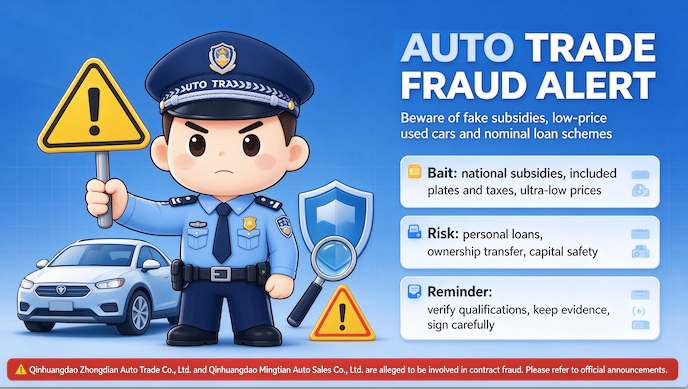
On September 23, 2026, a large group of victims filed reports at the Economic‑Development Zone Branch of Qinhuangdao Public Security Bureau in Hebei Province, exposing a fraud scheme operated for more than one year by Qinhuangdao Zhongdian Auto Trade Co., Ltd. and Qinhuangdao Mingtian Auto Sales Co., Ltd. Victims are scattered across China, with an estimated number of over one thousand. Multiple banks and auto‑finance institutions have been dragged into the case.
According to business registration records, Zhongdian Auto was incorporated in January 2024 and later set up branch offices in Tangshan and Baoding. Mingtian Auto was founded in November 2025, with its Tangshan branch established in August 2026.
Fraud Mechanism
Promoted on short‑video platforms such as Douyin and Kuaishou, the two firms lured consumers with national subsidies for car replacement. Victims fell into two traps:
- Nominal car‑loan takers Dealers convinced consumers with good credit records to take out auto loans under their own names. Victims were told they would only be nominal registered owners. Vehicles would be operated for leasing by the company, which promised to cover all monthly installments, pay off the full loan within one year, and complete title transfer. Victims would receive official car‑replacement subsidies.
In reality, the company never ran genuine leasing businesses. Instead, it resold the vehicles privately. It made timely monthly payments in the early phase to build credibility and draw in more victims.
- Actual car buyers The company sold “zero‑mile pre‑registered second‑hand cars” at prices 20 000‑30 000 RMB below market rates. Buyers were required to pay full price in cash, while immediate title transfer was denied. A sales agreement promised transfer within one year. Many buyers were tempted by the low price after seeing numerous displayed cars and onsite customers.
The scheme exploited zero‑down‑payment policies and dealer rebates from auto‑finance providers. The company acquired new cars at nearly zero cost and pocketed dealer rebates. The business model was unsustainable by design, amounting to a pre‑planned Ponzi‑style scheme.
Collapse and Victim Dilemmas
On September 20, 2026, the two companies issued notices announcing capital‑chain breakdown. They could no longer cover loan installments, settlements or title transfers. Controlling persons and management went missing.
- Nominal loan takers: Auto loans are registered under their personal identities. If they stop repayment, they will suffer damaged credit records and be listed as dishonest debtors. If they keep paying, they bear costs for vehicles used by others.
- Actual cash buyers: Though they hold the cars physically, titles remain under nominal loan takers. If nominal borrowers default, banks have the right to repossess vehicles. Buyers risk losing both money and cars. Some victims suffered losses from both traps simultaneously.
Status and Responsibilities of Financial Institutions
Involved banks and auto‑finance firms face potential bad‑debt losses. Red flags such as persistent mismatch between borrowers’ residential addresses and actual vehicle locations, plus early sporadic loan defaults, should have been flagged by risk‑control systems. A small number of financial institutions detected risks in advance and forced the company to settle outstanding loans.
Local police set up a dedicated service counter for victim registration. Official statistics on total victims and case value have not been released. Some nominal owners and actual car buyers attempted private settlements by sharing losses to pay off loans and transfer ownership, yet agreements are hard to reach for high‑loan cases. Financial institutions prefer private out‑of‑court settlements to avoid bad‑debt write‑offs.
Warnings
Similar auto‑sales contract fraud previously occurred in Jilin and Shanghai. Such scams prey mainly on consumers chasing bargains. Consumers should stay alert to unusual car‑deal arrangements. Financial institutions need stricter pre‑loan vetting and ongoing post‑loan risk monitoring.